JEE Main 2027: Best Free Online Platforms for Preparation, Complete Syllabus and Latest Updates
Published on October 26, 2026
Education Updates | Entrance Exams | Government Jobs
JEE Main 2027: Best Free Online Platforms for Preparation, Complete Syllabus and Latest Updates
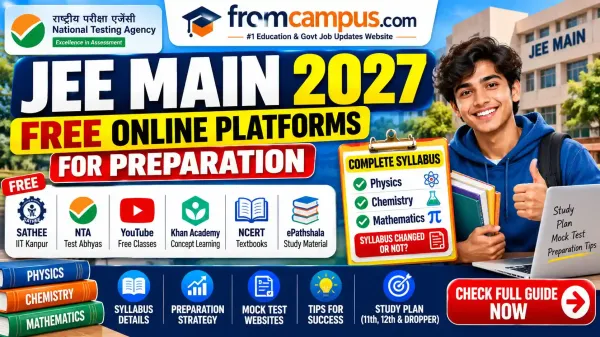
Preparing for JEE Main 2027 does not necessarily require expensive coaching classes. With the right study plan, reliable online resources, regular practice and consistent revision, students can prepare for the examination from home using free learning platforms.
The National Testing Agency (NTA) has published the JEE Main 2027 syllabus on its official website. According to the available syllabus information, the 2027 syllabus remains unchanged from 2026. Students preparing for engineering entrance examinations can use this information to organise their studies, identify important topics and begin systematic preparation.
In this FromCampus.com guide, you will find the best free online platforms for JEE Main 2027 preparation, subject-wise syllabus details, information about syllabus changes, mock test resources, and a practical study plan for Class 11, Class 12 and drop-year students.
JEE Main 2027: Overview
| Particulars | Details |
|---|---|
| Examination Name | Joint Entrance Examination (JEE) Main 2027 |
| Conducting Authority | National Testing Agency (NTA) |
| Main Purpose | Admission to eligible engineering and other participating programmes |
| Paper 1 | B.E./B.Tech |
| Paper 2A | B.Arch |
| Paper 2B | B.Planning |
| Main Subjects for Paper 1 | Physics, Chemistry and Mathematics |
| Syllabus Status | Published on the official website |
| Syllabus Release Date | 25 October 2026, as reported |
| Syllabus Changes | No changes from 2026 reported |
| Official Website | jeemain.nta.nic.in |
| Official Syllabus Page | JEE Main 2027 Syllabus |
Important: Always check the latest NTA information bulletin and official syllabus before making final decisions about the examination pattern, eligibility, marking scheme or application dates.
JEE Main 2027 Syllabus: Has NTA Changed the Syllabus?
One of the most common questions among engineering aspirants is whether the JEE Main 2027 syllabus has changed compared with the previous year.
According to the available 2027 syllabus information, there are no reported changes from the JEE Main 2026 syllabus. The Paper 1 syllabus contains 54 subject-wise units: 20 in Physics, 20 in Chemistry and 14 in Mathematics.
This means students who have already started preparing from the 2026 syllabus can continue studying the listed topics. However, they should download the official 2027 syllabus and compare it with their notes instead of relying only on coaching websites or social media posts.
Key syllabus updates
| Subject | Number of Units |
|---|---|
| Physics | 20 |
| Chemistry | 20 |
| Mathematics | 14 |
| Total | 54 |
The number of units is not a direct measure of difficulty or marks. Some units contain several concepts and require extensive numerical practice, while others may be more compact. Students should study the complete prescribed syllabus rather than choosing chapters only on the basis of predicted weightage.
How to download the official JEE Main 2027 syllabus
- Visit the official website: jeemain.nta.nic.in.
- Open the JEE Main 2027 syllabus section.
- Select the syllabus document for your examination paper.
- Download the PDF or accessible version.
- Compare the listed topics with your existing notes.
- Use the official syllabus as a checklist while preparing your study timetable.
Best Free Online Platforms for JEE Main 2027 Preparation
Students can use different platforms for concept learning, practice questions, mock tests and revision. The best strategy is to choose a small number of reliable resources and use them consistently instead of collecting too many courses.
1. SATHEE by IIT Kanpur
Website: sathee.iitk.ac.in
SATHEE is a free educational initiative associated with the Ministry of Education and IIT Kanpur. It provides JEE preparation resources, including learning materials, video lessons, previous-year questions and practice tests.
Students who cannot afford expensive coaching may use SATHEE as one of their main online preparation resources.
What students can use it for:
- Learning Physics, Chemistry and Mathematics concepts.
- Revising chapters through video lessons.
- Practising previous-year questions.
- Taking subject-wise and full-length tests where available.
- Identifying weak areas through practice and performance analysis.
Best for: Students looking for a structured, free preparation resource.
2. NTA National Test Abhyas
Website: NTA Abhyas
The National Testing Agency's test-practice initiative is useful for students who want to practise examination-style questions and improve their time management.
Mock tests are especially important because knowing a chapter is different from solving questions accurately under a time limit.
How to use it effectively:
- Attempt practice tests after completing relevant chapters.
- Practise answering questions within the prescribed time.
- Review incorrect answers after each test.
- Record the topics where mistakes occur repeatedly.
- Repeat weak-topic practice before attempting another full test.
Check the platform for current availability, supported examinations and test features.
Best for: Exam-style practice and improving speed and accuracy.
3. Khan Academy
Website: www.khanacademy.org
Khan Academy provides free educational lessons and practice materials in Mathematics and science. It can be helpful when students need to strengthen foundational concepts before attempting JEE-level questions.
For example, students who struggle with algebra, functions, trigonometry, calculus or basic Physics concepts can use introductory lessons to understand the fundamentals.
However, JEE Main also requires examination-specific problem-solving practice. Khan Academy should therefore be used as a supporting resource rather than the only preparation platform.
Best for: Building conceptual clarity and strengthening fundamentals.
4. YouTube Educational Channels
YouTube offers free lectures, chapter explanations, revision sessions and problem-solving discussions from various educational channels.
Students can use these lessons to understand difficult concepts, revisit missed topics and learn alternative approaches to numerical problems.
Recommended approach:
- Select one reliable teacher for each subject.
- Follow a complete chapter playlist rather than watching random videos.
- Make short notes while studying.
- Pause the video and attempt questions independently.
- Verify that the topics match the official JEE Main 2027 syllabus.
Free videos may be mixed with paid course promotions, so check whether the complete lesson or practice material is genuinely accessible without payment.
Best for: Chapter-wise learning and revision.
5. Official JEE Main Website
Website: jeemain.nta.nic.in
The official NTA website should be the first place to check examination-related information. It provides official notices, syllabus documents, information bulletins and other updates.
Students should not depend entirely on coaching websites for examination rules because unofficial pages may contain outdated dates or incomplete information.
Use the official website for:
- Downloading the prescribed syllabus.
- Reading the information bulletin.
- Checking registration and examination notices.
- Reviewing official instructions and eligibility conditions.
- Verifying changes announced by NTA.
Best for: Authentic examination information.
6. NCERT Textbooks and ePathshala
Websites: NCERT | ePathshala
NCERT textbooks are important supporting resources for JEE Main preparation, particularly for understanding the fundamentals of Physics and Chemistry and revising Class 11 and Class 12 concepts.
Students should read the relevant textbook sections alongside their problem-solving practice. Chemistry preparation can benefit from careful reading of definitions, reactions, properties and examples.
Best for: Strengthening textbook concepts and revising school-level fundamentals.
Free online platforms at a glance
| Platform | Main Purpose | Cost |
|---|---|---|
| SATHEE | JEE learning resources and practice | Free resources |
| NTA Abhyas | Test practice | Check current platform availability |
| Khan Academy | Conceptual learning and fundamentals | Free |
| YouTube | Lectures and revision | Free videos available |
| NTA JEE Main Website | Official syllabus and notices | Free |
| NCERT / ePathshala | Textbook study resources | Free digital resources |
Preparation tip: Use one main learning platform, one question-practice resource and the official syllabus. A simple and consistent system is usually easier to maintain than switching between several courses every day.
JEE Main 2027 Physics Syllabus: Complete Unit List
Physics requires both conceptual understanding and numerical problem-solving. Students should revise formulas, understand their conditions of use and practise applying them to unfamiliar questions.
The reported 2027 Paper 1 syllabus includes these 20 units:
| No. | Physics Unit |
|---|---|
| 1 | Units and Measurements |
| 2 | Kinematics |
| 3 | Laws of Motion |
| 4 | Work, Energy and Power |
| 5 | Rotational Motion |
| 6 | Gravitation |
| 7 | Properties of Solids and Liquids |
| 8 | Thermodynamics |
| 9 | Kinetic Theory of Gases |
| 10 | Oscillations and Waves |
| 11 | Electrostatics |
| 12 | Current Electricity |
| 13 | Magnetic Effects of Current and Magnetism |
| 14 | Electromagnetic Induction and Alternating Currents |
| 15 | Electromagnetic Waves |
| 16 | Optics |
| 17 | Dual Nature of Matter and Radiation |
| 18 | Atoms and Nuclei |
| 19 | Electronic Devices |
| 20 | Experimental Skills |
How to prepare Physics
Begin with fundamental mechanics concepts and then progress to other units according to your timetable. Maintain a formula notebook, but do not rely on memorisation alone.
For each chapter, learn the theory, solve basic examples, attempt JEE-level questions and analyse mistakes. Revise important formulas regularly and practise numerical questions under timed conditions.
JEE Main 2027 Chemistry Syllabus: Complete Unit List
Chemistry preparation should combine conceptual understanding, calculations, reaction-based learning and careful revision of prescribed textbook material.
The reported 2027 syllabus contains 20 units.
| No. | Chemistry Unit |
|---|---|
| 1 | Some Basic Concepts in Chemistry |
| 2 | Atomic Structure |
| 3 | Chemical Thermodynamics |
| 4 | Solutions |
| 5 | Equilibrium |
| 6 | Redox Reactions and Electrochemistry |
| 7 | Chemical Kinetics |
| 8 | Chemical Bonding and Molecular Structure |
| 9 | Classification of Elements and Periodicity in Properties |
| 10 | p-Block Elements |
| 11 | d- and f-Block Elements |
| 12 | Coordination Compounds |
| 13 | Purification and Characterisation of Organic Compounds |
| 14 | Some Basic Principles of Organic Chemistry |
| 15 | Hydrocarbons |
| 16 | Organic Compounds Containing Halogens |
| 17 | Organic Compounds Containing Oxygen |
| 18 | Organic Compounds Containing Nitrogen |
| 19 | Biomolecules |
| 20 | Principles Related to Practical Chemistry |
How to prepare Chemistry
For Physical Chemistry, practise calculations and understand the formulas used in each type of problem. For Organic Chemistry, build a strong foundation in reaction mechanisms, functional groups and the relationships between different reactions.
For Inorganic Chemistry, read the prescribed material carefully and revise important trends, properties and exceptions. Short revision sheets and spaced repetition can help students retain information for longer.
Always cross-check the complete topic-level details against the official syllabus PDF.
JEE Main 2027 Mathematics Syllabus: Complete Unit List
Mathematics requires regular problem-solving practice. Students should understand the concepts behind formulas and learn to identify the most efficient method for solving each question.
The reported syllabus contains 14 units.
| No. | Mathematics Unit |
|---|---|
| 1 | Sets, Relations and Functions |
| 2 | Complex Numbers and Quadratic Equations |
| 3 | Matrices and Determinants |
| 4 | Permutations and Combinations |
| 5 | Binomial Theorem |
| 6 | Sequence and Series |
| 7 | Limits, Continuity and Differentiability |
| 8 | Integral Calculus |
| 9 | Differential Equations |
| 10 | Co-ordinate Geometry |
| 11 | Vectors Algebra |
| 12 | Statistics and Probability |
| 13 | Trigonometry |
| 14 | Three Dimensional Geometry |
How to prepare Mathematics
Solve questions every day, even when your primary focus is another subject. Start with basic examples, move to moderate problems and then practise previous-year questions.
Keep a separate notebook for mistakes. If you repeatedly make errors in algebra, signs, calculations or formula selection, revise that topic before moving to more difficult questions.
JEE Main 2027 Preparation Strategy for Students
A practical preparation plan should include learning, practice, revision and testing. Students do not need to study every chapter for the same amount of time; the time required depends on their understanding and the difficulty of the topic.
Step 1: Download the syllabus and make a checklist
Divide the syllabus into three categories: not started, currently studying and completed. Mark a chapter as completed only after you have studied the concepts and solved relevant questions.
Step 2: Build a daily study routine
A possible routine for students who have sufficient study time is:
| Activity | Suggested Daily Time |
|---|---|
| Physics theory and problems | 2 hours |
| Chemistry theory and practice | 2 hours |
| Mathematics problem-solving | 2 hours |
| Revision and error analysis | 1 hour |
| Total | 7 hours |
This is only an example, not a compulsory schedule. School students should adapt it to their classes, homework, health and available time.
Step 3: Practise previous-year questions
Previous-year questions help students understand how concepts are tested and where they struggle. Solve them chapter-wise after studying the corresponding topics.
Do not merely check the correct option. Understand why the answer is correct and why your own approach did or did not work.
Step 4: Take mock tests regularly
Begin with chapter tests and gradually add mixed-topic tests and full-length mock tests. After each test, review incorrect answers, unattempted questions and questions that took too much time.
A mock test is valuable only when you learn from the result.
Step 5: Revise consistently
Reserve time each week for revision. Revisit formulas, reactions, important concepts and previous mistakes. Short, repeated revision sessions can be more manageable than trying to revise everything just before the examination.
Common Mistakes to Avoid During JEE Main 2027 Preparation
- Using too many resources: Switching between multiple teachers and courses can waste time. Choose reliable resources and finish what you start.
- Ignoring the official syllabus: Do not spend substantial time on topics without checking whether they are prescribed for your paper.
- Watching lectures without solving questions: Passive learning alone does not develop examination-level problem-solving ability.
- Avoiding weak chapters: Identify difficult topics early and improve them through focused practice.
- Neglecting Chemistry revision: Regular revision is important for retaining concepts, reactions and factual details.
- Taking mock tests without analysis: Review every test to understand your errors and improve your approach.
- Trusting unverified syllabus-change claims: Confirm syllabus and examination updates on the official NTA website.
Frequently Asked Questions (FAQs)
1. Has the JEE Main 2027 syllabus changed from 2026?
Available reports indicate that the JEE Main 2027 syllabus remains unchanged from the 2026 syllabus. Candidates should still download the official 2027 syllabus and verify the topic-level details before finalising their study plan.
2. Where can I download the JEE Main 2027 syllabus PDF?
Students can visit the official NTA website at jeemain.nta.nic.in. Open the syllabus section and download the document relevant to Paper 1, Paper 2A or Paper 2B.
3. Which free platform is best for JEE Main 2027 preparation?
SATHEE, Khan Academy, YouTube lessons, NCERT digital resources and NTA practice resources can all support preparation. The most suitable combination depends on whether a student needs concept learning, revision, question practice or mock tests.
4. Can I prepare for JEE Main 2027 without paid coaching?
Yes, students can use free learning resources, textbooks, previous-year questions and mock tests to build a preparation plan. Success depends on consistent study, regular practice, revision and honest analysis of mistakes rather than the price of a course.
5. How many units are listed in the JEE Main 2027 Paper 1 syllabus?
The reported Paper 1 syllabus contains 54 units in total. These comprise 20 Physics units, 20 Chemistry units and 14 Mathematics units.
6. Should I study NCERT books for JEE Main 2027?
NCERT textbooks are useful for building fundamentals and revising prescribed topics, especially in Chemistry. Students should combine textbook study with JEE-level numerical practice and previous-year questions.
7. How many hours should I study every day?
There is no single number of study hours that suits every student. Make a realistic timetable that covers all three subjects, revision and practice while allowing adequate sleep and breaks.
8. Are YouTube lectures enough for JEE Main preparation?
YouTube lectures can help students understand concepts and revise difficult chapters. However, students also need independent problem-solving practice, previous-year questions, mock tests and regular revision.
Final Words
JEE Main 2027 preparation can be organised effectively with the help of free online learning resources, textbooks, previous-year questions and regular mock tests. Students should begin by downloading the official syllabus, building a realistic timetable and selecting a small set of resources they can use consistently.
The available syllabus information indicates no changes from 2026, but the official NTA document remains the final reference for the prescribed topics. Focus on understanding concepts, practising questions, revising regularly and learning from every test.
For more entrance examination updates, study resources, syllabus information and education news, keep visiting FromCampus.com.
Disclaimer: This article is intended for educational guidance. Students should verify the latest syllabus, examination pattern, eligibility requirements and official notices directly on the NTA JEE Main website before making examination-related decisions.